

If you run a dye-sublimation calender, ghosting is not a new word. It’s the faint double image that appears on fabric where it shouldn’t — a blurred halo that turns a metre of good fabric into a metre of waste.
Most content on sublimation ghosting is written for small-format producers. It talks about heat tape, hand presses and misaligned transfers. That’s a different problem. Industrial ghosting on a roll-to-roll calender has different causes, a different scale and significantly higher costs.
This article addresses the problem in the context where you actually operate: continuous roll-to-roll production, industrial calenders, technical polyester fabrics. And it explains — with numbers — why calender protection paper is consistently the most underestimated variable in the equation.
What calender ghosting actually is — and why it isn’t a settings problem
Ghosting is an unintended secondary transfer. Dye-sublimation ink that should move from paper to fabric in a single controlled heat cycle instead leaves residual marks out of position.
In small-format production (flatbed heat presses, individual pieces), ghosting is almost always a mechanical displacement issue: the paper shifts as the press opens and the still-hot ink touches the fabric in a slightly different position. Simple fix: heat-resistant tape, faster separation, tacky paper.
In roll-to-roll calender production the mechanism is different.
The calender runs continuously. Transfer paper and fabric advance together, compressed against the heated drum, then separate. It is at that separation point — when the drum opens and the paper peels away from the fabric — that the problem occurs. If the paper, still hot and carrying residual dye, makes contact with the fabric again for even an instant (in a slightly shifted position), you have ghosting.
At low advance speeds the risk is manageable. At production speeds (15–30 m/min or higher) it becomes systematic. Any variable that extends paper-to-fabric contact time after separation is a risk variable.
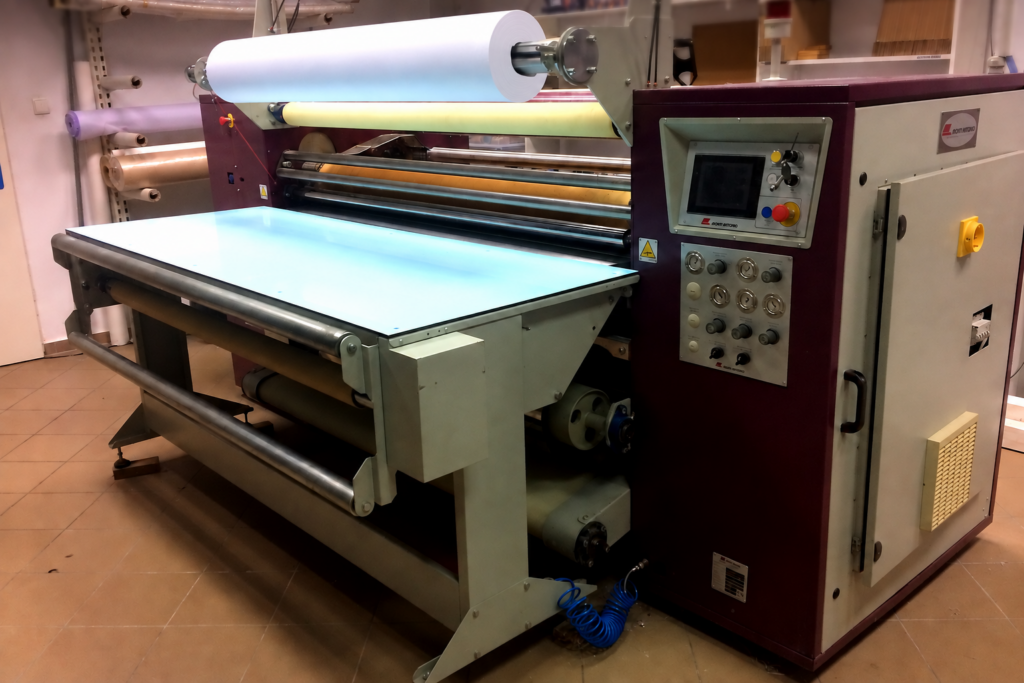
The four main causes of ghosting in calender production
Identifying the correct cause is the first step towards the right solution. These causes are not mutually exclusive: in practice they often compound each other.
1. Second-release effect
During thermal transfer the ink does not migrate all at once. A residual fraction always remains on the transfer paper after the first pass. If the paper stays in contact with the fabric beyond the optimal separation point — or is pulled back towards it by irregular mechanical tension — that residual fraction transfers out of register.
2. Missing or inadequate calender protection paper
Calender protection paper has a specific role: to create a controlled barrier between the transfer paper and the calender blanket, to manage the release zone and to prevent re-contact. When this paper is absent, or when a generic silicone-coated paper not engineered for the temperatures and speeds of an industrial calender is used, the release zone becomes uncontrolled.
3. Uneven fabric tension during advance
If the fabric advances under variable tension — for mechanical reasons, or because the fabric itself has non-uniform elastic behaviour — separation from the paper does not occur along a straight line. Residual contact points equal ghosting points.
4. Transfer paper curl under heat
A sublimation paper with poor dimensional stability under heat tends to curl slightly during its calender pass. Even a minimal deviation in flatness can create micro-zones of unplanned contact with fabric that has already separated.
The technical role of calender protection paper: what it actually does
Calender protection paper is not an accessory. It is a technical component of the process. It performs three main functions:
1. Release zone control
By positioning itself between the transfer paper and the drum, the protection paper physically defines where and how separation occurs. A paper engineered with the correct release coefficient ensures clean separation, without drag and without re-contact.
2. Thermal barrier against residual dye
Protection paper must be chemically and physically inert to dye-sublimation inks — it must not absorb colorant and it must not transfer it. The wrong material (a silicone-coated packaging liner, for example) can absorb traces of colorant and release them onto the calender blanket, where they will inevitably be re-transferred onto fabric in later production runs, generating deferred ghosting that is far harder to diagnose.
3. Even heat distribution
The drum of an industrial calender has surface temperature variations across its width. A protection paper with the right thermal mass helps distribute heat more evenly, reducing anomalous temperature zones that drive both ghosting and localised over-transfer.
How to evaluate calender protection paper: the parameters that matter
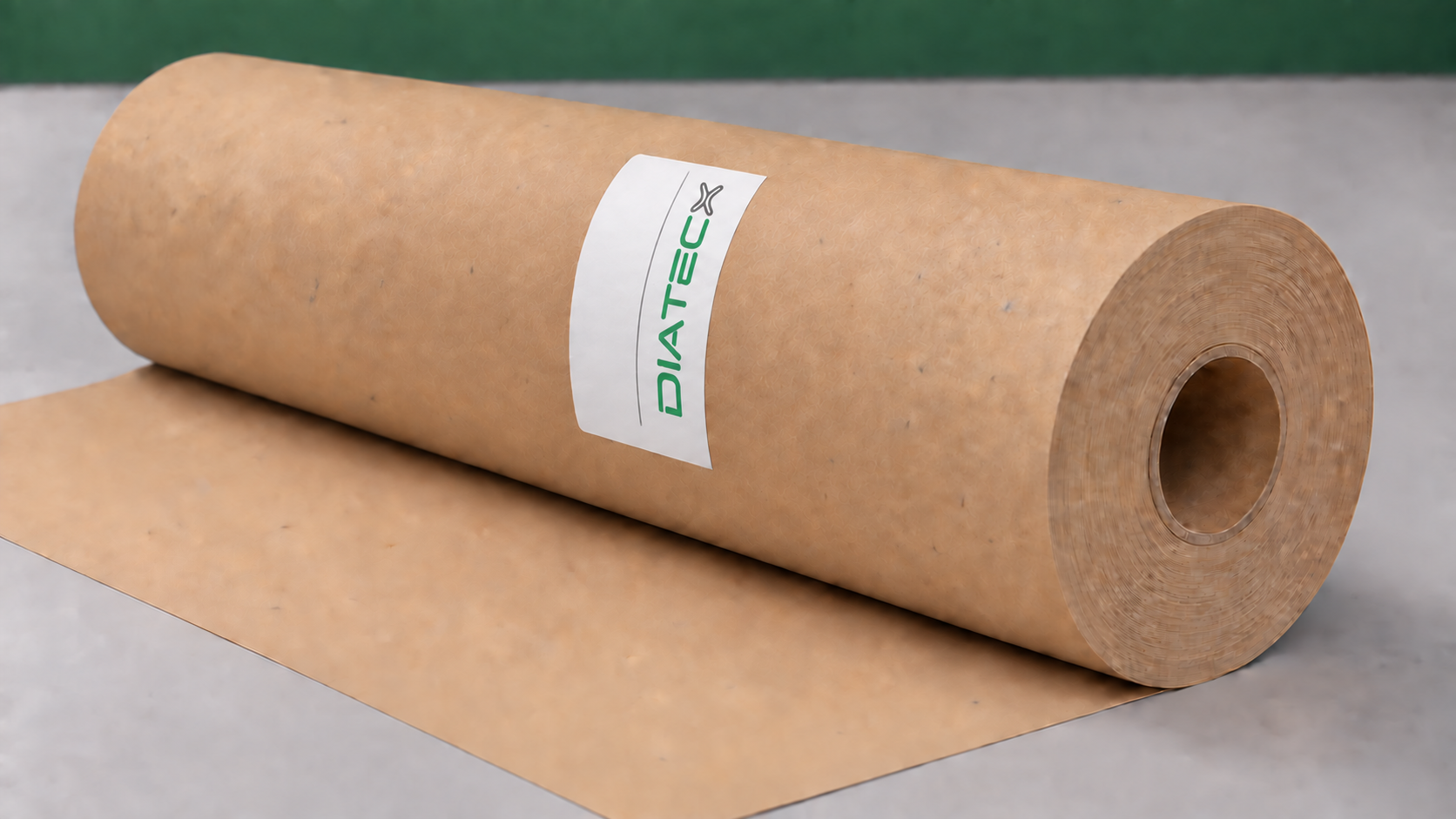 Not all calender protection papers are equivalent. These are the technical parameters to verify before bringing a product into production.
Declared and verified operating temperature
Industrial calenders typically run between 170°C and 210°C (340–410°F). Protection paper must maintain its release, barrier and chemical neutrality properties across this entire range. Note: many papers declare a maximum temperature without specifying performance at that temperature. Ask for technical data, not headline figures.
Dimensional stability under sustained heat
Paper that shrinks or swells under sustained heat loses contact uniformity and introduces uncontrolled variables. Check the manufacturer’s dimensional variation data, ideally tested at operating temperature for at least 30 continuous minutes.
Compatibility with advance speeds
Paper engineered for slow speeds may not perform at high speeds, and vice versa. Your supplier should be able to state the optimal speed range for the product.
Grammage and roll longevity
Grammage affects both thermal mass and paper rigidity. Inadequate grammage means more frequent protection roll changes, with a direct impact on operating cost and production continuity.
Environmental credentials
As supply chain sustainability comes under closer scrutiny from brand clients, protection paper manufactured at an ISO 14001 certified facility makes a difference. This is not only an ethical question: it is increasingly a documented requirement in supply specifications.
What does ghosting really cost? A reference calculation
Ghosting costs accumulate across three items that are often calculated separately but share the same root cause.
Scrapped metreage: a 1.67m (66in) calender running at 20 m/min produces 1,200 m/hour. If recurring ghosting causes a 5% scrap rate, that is 60 metres per hour. On technical sportswear fabrics (average raw material cost: €4–8/m²), that represents €390 to €780 per hour in pure waste.
Rework cost: identifying, cutting out and handling defective runs requires machine time and operator time. In industrial production, rework cost often exceeds the cost of the scrapped material itself.
Client impact: when defects reach the client, the impact is not only financial (returns, replacements) but reputational. In markets such as technical sportswear — where colour accuracy and repeatability are commercial prerequisites — even a single defective batch can compromise a supply relationship.
The maths is clear: if replacing an inadequate calender protection paper with one engineered for the industrial process reduces ghosting from 5% to just 1%, return on investment is measured in days, not months.

Checking your production line: the operational checklist
If ghosting is recurring in your production, these are the steps to work through in the correct order.
Before touching any machine settings:
- Is the calender protection paper in use engineered for continuous operation above 180°C?
- Is the protection paper compatible with water-based dye-sublimation inks (the most common in industrial calenders)?
- Is the grammage of the protection paper matched to your calender’s advance speed?
If the protection paper checks out:
- Is fabric advance tension uniform across the full working width?
- Does the sublimation paper in use deliver dimensional stability under heat?
- Is drum temperature uniform (verified with thermal imaging)?
In the majority of recurring ghosting cases we have analysed in our clients’ processes, the root cause was in the first section of this checklist — not in the machine settings.
How we work with textile manufacturers on these problems
Diatecx manufactures and converts sublimation papers and calender protection papers at its own facilities in Europe. We work with industrial textile manufacturers running calenders of different makes and configurations.
Our approach is not to sell a standard product and leave the client to run empirical trials. When a manufacturer contacts us with a ghosting problem, we ask for the specific parameters of their calender — advance speed, operating temperature, working width, fabric type — and recommend the specific combination of sublimation paper and calender protection paper best suited to that process.
If you are experiencing recurring ghosting and want to analyse the cause together with our technical team, get in touch. Bring us your process parameters and we’ll find the solution together.
Diatecx S.p.A. | Certifications: ISO 9001, ISO 14001, ISO 22000, FSC
Sublimation papers and calender protection paper: standard and custom formats